
"My liberation is tied up in yours."
Soul Liberation Fund
Access to facilitated, state-regulated plant medicine for Portland-area people impacted by addiction, and for the peers who walk beside them.
Whether you're applying, supporting, or just curious, thanks for being here.
Before you continue, we invite you to pause for five seconds and take one slow, deep breath.
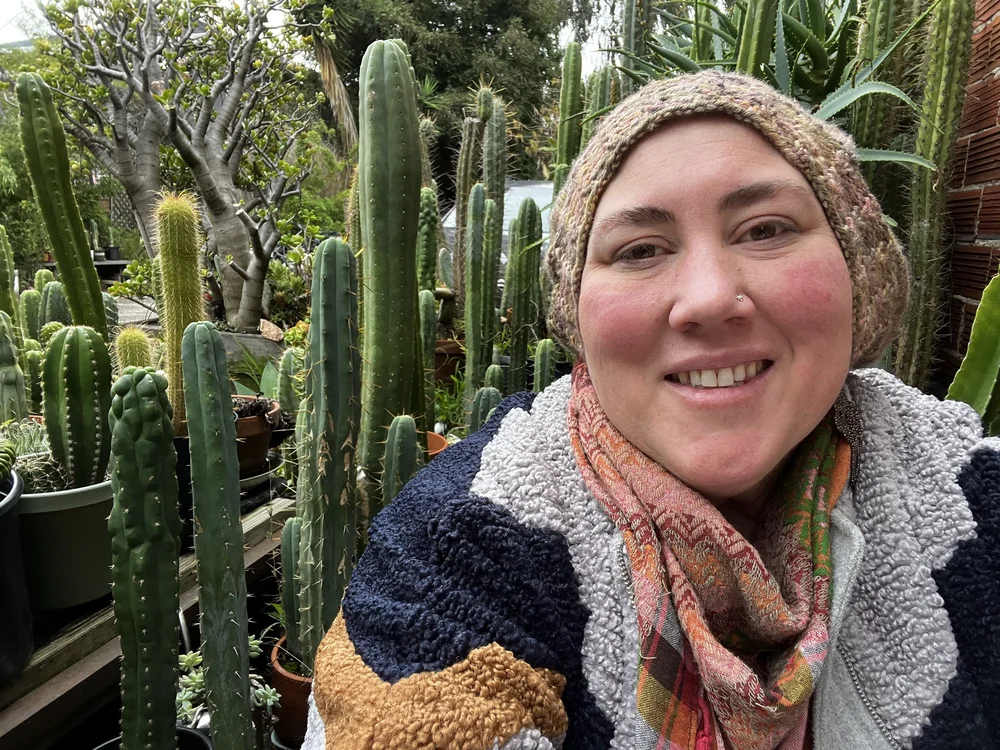
A note from Sarah Honeycutt
The medicine opens a door. The work is walking through it.
At the tender age of 13, I was shunned from my family's fundamentalist religious community. This left me on my own to discover life. I left high school after 10th grade, got my GED, and eventually earned a master's in economics. I came up in the rave scene, where I discovered community and belonging. Along the way I created my own story. In the deep study of the Yogic Eightfold Path I found my center. In sitting with Soto Zen monks, meditating three hours a day for two years, I deepened my abilities to witness the mind without judgement. I have become more myself, letting parts go and remembering parts forgotten. Today, I want to be the person I needed all those years ago, a guide that serves empathy alongside reality.
Plant medicine is one part of my journey, a very magical part, and only one part. The real transformation has come from the full arc of the work: meditation, study, community, preparation, integration, and showing up for myself over and over again. My reverence for plant medicine has taken me around the world, studying with wisdom keepers, learning from cultures that have held this knowledge for generations, and advocating for widespread access to plant medicine. I will always be honest that the medicine alone isn't the answer. It opens a door. The work before and after is what lets you walk through it.
Today I bring over 20 years of experience in psychedelic spaces and I have walked in many of the places you may go. I am a state-licensed psilocybin facilitator, an advocate for equitable access, and someone who found her own path to personal liberation and wants to pay that forward. This work changes lives, and I know that because it changed mine. Supporting people with lived experience works; I know, because that's me. A small change can have a big impact, and I am very excited to be paying forward the generosity I received from the Sheri Eckert Foundation. I bring humor, realness, and a loving kindness that doesn't judge.
~ Sarah
Take a breath. Trace the path.
Jump to a section of this page
The Fund
Our community is deep in crisis. The people on the front lines feel it most.
Nearly one in five Oregonians struggles with substance use disorder, and 80% of those who need treatment don't receive it. More than 12,000 people are experiencing houselessness in Portland, and the state consistently ranks among the worst in the nation for access to mental health care.
Across the Portland Metro, individuals with their own lived experience of addiction, housing insecurity, trauma, and mental health challenges have done the hard work of building stability. Many have completed Oregon Health Authority certified Peer Support Specialist and Peer Wellness Specialist trainings and now dedicate their lives to serving community members still navigating those same struggles. They show up day in and day out as peer specialists, outreach workers, and counselors in shelters, outreach programs, and service organizations across the metro. They know what recovery demands because they've lived it.
Emerging research confirms that psilocybin and other plant medicines can be profoundly effective for substance use disorder, anxiety, depression, PTSD, and more. Oregon's regulated model offers real promise, but at $2,500 to $3,500 out of pocket and no insurance coverage, that promise remains out of reach for the very people most likely to benefit and pay it forward.
The Soul Liberation Fund was co-created to close that gap. We support Portland Metro residents, 21 and older, who carry lived experience, work directly with populations currently facing addiction, housing insecurity, mental health challenges, and trauma, and face financial barriers to accessing facilitated, state-regulated plant medicine sessions, with a preference for those who have completed Oregon Health Authority certified Peer Support Specialist type trainings. Their healing and exploration strengthens the entire community.
Who Can Apply
Built for the people already doing the work.
We support Portland Metro residents, 21 and older, who carry lived experience of addiction, housing insecurity, mental health challenges, and/or trauma, who work directly with populations facing those same struggles, and who face financial barriers to accessing facilitated, state-regulated psilocybin sessions.
If you've done the hard work of building stability in your own life and now show up for others as a peer specialist, outreach worker, counselor, or in another frontline role, this fund was built with you in mind.
Questions about whether you qualify? Email sarah@sherieckert.org.
To qualify, applicants generally:
- ✓ Are 21 years or older
- ✓ Live in the Portland Metro area
- ✓ Carry lived experience of addiction, housing insecurity, trauma, or mental-health challenges
- ✓ Work directly with communities facing those same struggles
- ✓ Face financial barriers to accessing facilitated plant-medicine care
Preference is given to those who have completed Oregon Health Authority–certified Peer Support Specialist or Peer Wellness Specialist training.
What's Covered
What the grant includes, and what it doesn't.
$500 – $2,300
Typical grant size. Final amounts vary with financial need, and the funds go directly to an OHA-licensed facilitator or service center once you've agreed to work together.
Covers facilitation
The grant supports the cost of professional facilitation. Recipients can be referred to Sarah Honeycutt or one of our recommended facilitators experienced with addiction.
Not the medicine
It does not cover the plant medicine itself (~$150, recipient's responsibility) or any travel, food, or lodging costs.
How to Apply
Applying for a grant
The application is completed through a secure Typeform. It can take up to an hour, because it walks you through what's involved in receiving plant-medicine services in Oregon, alongside personal, financial, mental-health, facilitation, and integration questions.
Grants are awarded through a competitive process, selection weighs financial need, membership in an underserved community, and a demonstrated readiness for psilocybin therapy. Our goal is to award initial grants in Spring 2026, and we communicate with every applicant over email.
Questions? Reach us anytime at sarah@sherieckert.org. Please add the address to your contacts and check your spam folder.
The path, step by step
- 1Submit the Typeform application (about an hour)
- 2Selection based on need, community, and readiness
- 3Get matched with a vetted, licensed facilitator
- 4Preparation, your session, and integration support
The Case · Why this matters
Most addiction begins as pain. The newest science can reach it, and the math is staggering.
Follow the thread: the scale of the crisis, where it really comes from, what the research now shows, how many people a fund like this can reach, and what every dollar gives back. Each figure below is sourced, tap the citations.
01 · The scale of it
A single-night homelessness count understates the annual total; Oregon and U.S. figures are the most recent finalized federal releases.
02 · Where it really comes from
Addiction is rooted in trauma. Build a childhood and watch the risk move.
The CDC–Kaiser Adverse Childhood Experiences (ACE) Study followed 17,000+ adults. Each block is one category of childhood adversity, abuse, neglect, a household shaped by addiction, violence, or loss. Tap to add them.
ACE score: 0 of 10
The basic cause of addiction is predominantly experience-dependent during childhood, not substance-dependent.
03 · What the research now shows
Reach the trauma underneath, and addiction can move. In just one to three sessions.
Psychedelic-assisted therapy doesn't manage symptoms day by day, it works on the wound. Here is the strongest current evidence, next to today's leading treatments. Smaller, early trials are labeled as such.
Two psilocybin sessions + therapy
NYU Langone, double-blind RCT, JAMA Psychiatry 2022 · n = 95
Heavy-drinking days fell to 9.7% with psilocybin vs 23.6% on placebo. JAMA Psychiatry 2022
Today's leading medications
Naltrexone & acamprosate · meta-analysis of 64 trials
Number-needed-to-treat of 8–9, modest effect sizes that require ongoing daily dosing. Maisel 2013 · NIDA relapse data
Psilocybin + cognitive behavioral therapy
Johns Hopkins pilot (n = 15, open-label) · 2014 / 2017 follow-up
Smokers averaging 19 cigarettes a day for 31 years, with 6 prior failed quit attempts. Biologically verified. JHU 2014
Standard cessation aids
12-month continuous abstinence
Pilot is small and open-label, but the signal dwarfs the standards. FDA / varenicline trials
Psychedelics & opioids
Population study · n = 44,678 (NSDUH)
Ibogaine pilot (n = 30): 50% reported no opioid use a month after a single treatment. Pisano 2017 · Brown & Alper 2018
The status quo
NIDA · relapse in treated substance use disorder
Population findings are correlational; trials are early. The pattern, repeatedly, points the same direction. NIDA
Durability is the difference. These outcomes follow just 1–3 supervised sessions, and the Johns Hopkins group remained 60% abstinent at an average of 30 months. No published trial yet pits psilocybin head-to-head against these medications; we present each plainly, side by side.
04 · How far a fund can reach
Move the slider. Watch the people.
A Soul Liberation Fund grant averages about $1,400, the cost of facilitated care for one person. See how many neighbors a given gift reaches, and how many would likely not be reached by today's standard treatments.
Each square represents one person.
"Reached beyond standard care" applies the controlled gap from the alcohol trial, ~24 additional people in lasting remission for every 100 treated, vs. an active comparison. Illustrative; real outcomes vary by person and condition.
05 · What every dollar gives back
The return on healing
Addiction already costs us a fortune. We pay it in ERs, jails, and lost lives.
Set the inputs. The model uses independently established per-person costs of addiction and a recovery rate you control.
Modeled illustration. Per-person avoided-cost levers, healthcare $19,000/yr, lost productivity $14,707/yr, criminal-justice $6,961/yr (and quality-of-life $234,478/yr), from CDC MMWR 2021 & the White House CEA 2025. As an independent benchmark, NIDA finds addiction treatment returns $4–$7 per $1 (up to 12:1 with healthcare). No psilocybin-specific SUD cost study exists yet.
06 · Why this is the place to put a dollar
First philanthropists. Then states. Then insurers. The order the money always follows.
The highest-leverage gift in mental health
The need is proven, the cost per healing is small, and no insurer covers it yet. A handful of donors can fund dozens of recoveries today, and seed the outcome data that unlocks everything after.
Pay upstream, not down
Oregon already absorbs $4.8B a year in alcohol harm alone and $6.7B in substance-related spending. States that fund the care up front spend less on the ERs, jails, and child-welfare cases downstream.
Cheaper than relapse
Once durability is established, covering 1–3 sessions costs an insurer far less than years of relapse, hospitalization, and chronic care. The math that moves philanthropists first will move payers next.
The bottom line
The cost is a rounding error next to the savings.
Addiction costs the United States more than $740 billion every year, and the opioid crisis alone runs to an estimated $2.7 trillion. Against numbers like those, the price of healing one person is almost nothing. For a philanthropist today, this is among the highest-return, most human places to put a dollar. For governments and insurers tomorrow, it will simply be good math. The Soul Liberation Fund is where that future starts, one person, one community, at a time.
Fernlove
Where healing can happen.
Many Sheri Eckert Foundation grantees receive their psilocybin care at Fernlove, Oregon's only licensed psilocybin service center with on-site lodging, set on thirty forested acres an hour west of Portland. Licensed facilitators, regulated medicine, and the quiet of the forest.
Fernlove works exclusively with licensed facilitators and psilocybin from licensed manufacturers. It's one of the places Soul Liberation Fund recipients may journey, though not every grantee comes here, you can also be matched with Sarah Honeycutt or another recommended facilitator closer to home.
Learn more about the foundation's partnersSupport the Fund
Your gift becomes someone's healing.
The Soul Liberation Fund is powered by donations, so the more we raise, the more grants we award. Every contribution moves a Portland neighbor with lived experience closer to care they couldn't otherwise reach, and pays the generosity forward into the whole community.
FAQ
Frequently asked questions
The Soul Liberation Fund supports individuals impacted by addiction by reducing the financial and logistical barriers to accessing facilitated, state-legal plant-medicine services.
We support Portland Metro residents, 21 and older, who carry lived experience of addiction, housing insecurity, mental health challenges, and/or trauma, who work directly with populations currently facing those same struggles, and who face financial barriers to accessing facilitated, state-regulated psilocybin sessions. We give preference to applicants who have completed Oregon Health Authority certified Peer Support Specialist or Peer Wellness Specialist trainings.
If you are someone who has done the hard work of building stability in your own life and now shows up for others navigating similar challenges, as a peer specialist, outreach worker, counselor, or in another frontline role, this fund was built with you in mind.
If you have questions about whether you qualify, please email us at sarah@sherieckert.org.
While research reveals a strong safety profile, psilocybin is not for everyone, and some conditions may be disqualifying. Depending in part on the Psilocybin Facilitator or Service Center, the following conditions or situations may be contraindications:
- Mental-health conditions such as schizophrenia, schizoaffective or schizophreniform disorder, major depressive disorder with psychotic features, psychotic disorder, bipolar disorder, mania, delusional disorder, any dissociative disorder, substance-induced psychosis, or severe paranoia
- Current drug or alcohol withdrawal symptoms, or active/severe drug or alcohol misuse
- Cardiovascular conditions (e.g. poorly controlled high blood pressure, prolonged QTc, congestive heart failure, history of cardiac arrest or ventricular arrhythmia, AICD, coronary artery disease, angina, tachycardia, atrial fibrillation, Wolff-Parkinson-White, heart-valve disease, cardiomyopathy, aortic disease, aneurysms)
- Gastrointestinal conditions such as moderate-to-severe liver impairment or gastric-outlet obstruction
- Dialysis or severe kidney disease
- Neurologic conditions such as dementia, cognitive impairment, seizure disorders, epilepsy, history of stroke or TIA, cerebral aneurysm
- Medications such as lithium, two or more medications affecting your serotonin system (SSRI, SNRI, SPARI, TCA, MAO inhibitors), or treatment for angle-closure glaucoma
- Pregnancy
- Tuberculosis, COVID, and other highly contagious diseases
- A first-degree relative with schizophrenia, bipolar disorder, or any psychotic or dissociative disorder
If you live with any of the above and cannot resolve it before receiving psilocybin therapy, we recommend you do not apply, as eligibility is unlikely. Legally, someone cannot receive psilocybin if they: have been diagnosed with active psychosis; take or have taken lithium within the past 30 days; or have ideation of harm to themselves or others.
We are not deciding whether someone should receive psilocybin services, only whether an applicant is a good fit for a grant, so they can pursue a licensed facilitator with whom they'll jointly decide whether to work together.
In 2020, Oregon voters passed Ballot Measure 109, the Oregon Psilocybin Services Act, allowing the manufacture, delivery, and administration of psilocybin within licensed service centers, supervised by licensed facilitators. In 2022, Colorado became the second state to establish a regulated access program. While psilocybin is legal within the Oregon and Colorado state-regulated models, it remains a federally illegal Schedule 1 drug under the Controlled Substances Act.
The Soul Liberation Fund is an initiative of the Sheri Eckert Foundation (SEF), in partnership with Sarah Honeycutt, an Oregon-licensed facilitator and integration coach, with an initial gift from a generous private Portland resident.
SEF is committed to a future where Oregon's and Colorado's evolving psychedelic ecosystem is accessible to participants from diverse backgrounds, means, and geographies. Learn more about SEF here. Our Board of Directors is David Bronner, Tom Eckert, and Nathan Howard. Our team consists of Nathan Howard, Executive Director, and Lorena Dame, Director of Operations and Development. We also work with Magical Teams to support our application process.
Visit the State of Oregon's official Oregon Psilocybin Services site, which includes sample forms such as the Informed Consent and Client Bill of Rights, plus a Scientific Literature Review. Another comprehensive guide is the Healing Advocacy Fund's Oregon Psilocybin Services Client Guide.
Final grant amounts vary, but we anticipate an average grant size of $500–$2,300. The grant supports the cost of facilitation; it does not cover the cost of the plant medicine, which ranges from potentially donated to around $150. Grants do not cover travel, food, or lodging.
Funds are directed to the facilitator and/or service center, which must be licensed by the Oregon Health Authority (OHA). Once you and a facilitator agree to work together, we direct the funds to them. Recipients can be referred to Sarah Honeycutt or one of our recommended facilitators.
Our goal is to award initial grants in Spring of 2026. We communicate with all applicants over email.
Grants are awarded through a competitive application process, since applicants may exceed the funds we can distribute. Selection is based primarily on financial need, whether the applicant belongs to an underserved population (e.g. geography, race, ethnicity, cultural barriers, occupation, ability, age, gender), and a demonstrated understanding and readiness to receive psilocybin therapy. Each category is detailed in the application.
The fund is currently designed to support groups of three individuals undergoing one day of psilocybin facilitation. The cohort model fosters peer support and ongoing community, while improving quality of care and lowering overall costs. If an applicant would prefer individual care, they can indicate so in the application, and the request will be considered as needed.
Why group over one-on-one? Group work became less common in recent Western medicine, driven by the FDA's approach to drug development. Yet psychedelics, especially psilocybin, have a long, successful history of use in group settings, from clinical contexts to Indigenous cultures going back thousands of years. Group work saves time and money, and studies show that feeling part of a community improves well-being and connectedness. People who start out preferring individual care often end up strongly preferring group, and we know from research and experience that people rarely heal in isolation. Research suggests combining psychedelics with group psychotherapy can increase connectedness and interpersonal learning.
Any information you share is strictly confidential and will not be shared with any person, for any reason, without your written (or electronic) permission. Submission is voluntary, and refusal will not subject you to any adverse treatment. The Sheri Eckert Foundation uses, processes, and stores your personal information only to review, manage, and execute the fund's program. All workstations and Typeform devices are fully encrypted, and Typeform's data-protection standards are HIPAA compliant. We do not share, sell, or lease your information to third parties unless required by law.
Yes. All workstations and Typeform devices are fully encrypted to guarantee the confidentiality of the information they contain, and Typeform's data-protection standards are HIPAA compliant.
› Sources & methodology for the data above
Grants are open
Take 30 seconds to complete our interest form to receive a grant from us.
Complete the interest formTakes 30 seconds